
 ← All tools
Fertile Window Calculator 🌱
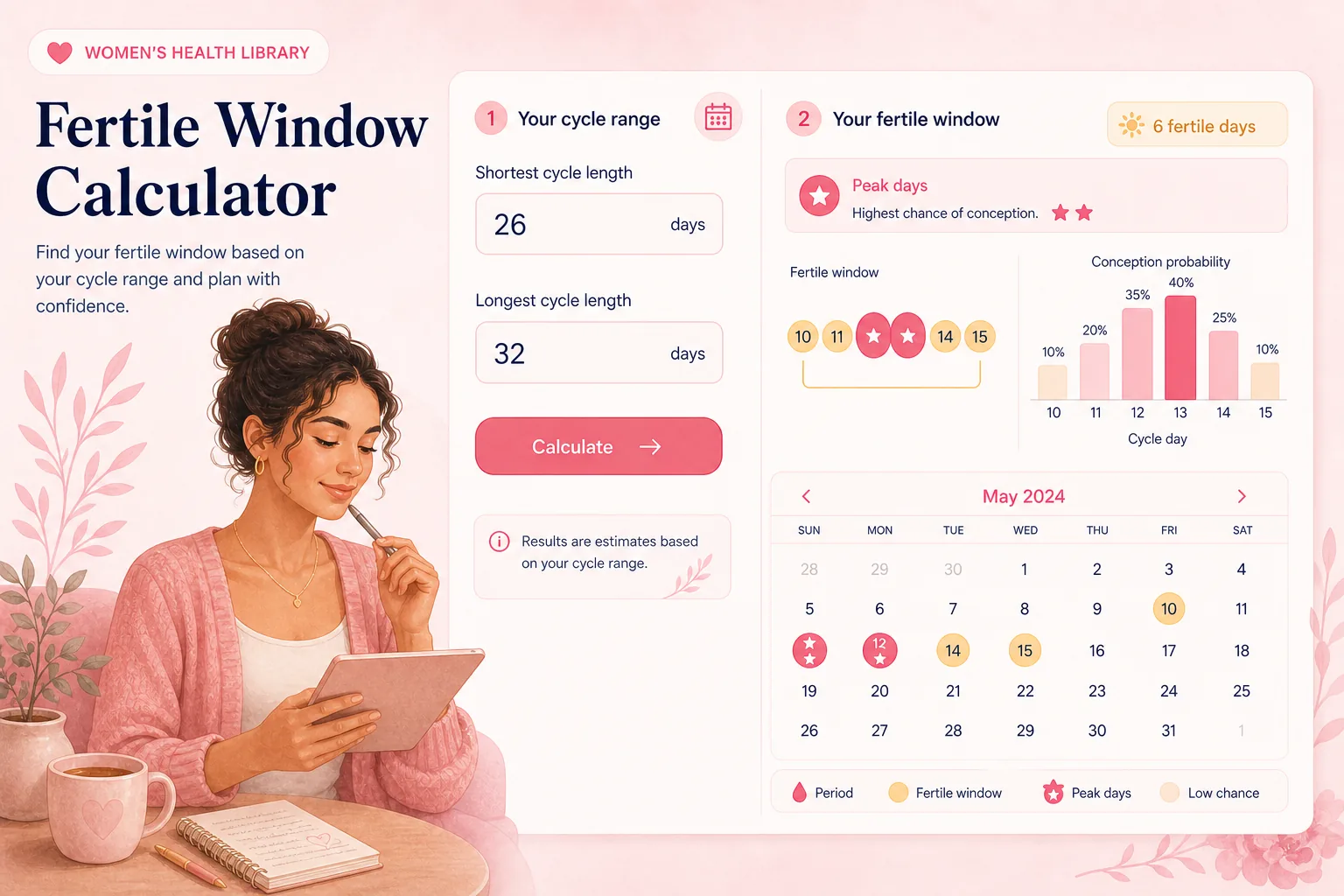
Find the six days each cycle when you're most likely to conceive, so you can time things with confidence — not pressure.
Free account
Trying to conceive? Track it with a free account 💛
Save your fertile window, and when you get that positive test, follow your pregnancy week by week with reminders — all free.
Already a member? Log in
How your fertile window works
Ovulation is when an ovary releases an egg — usually about 14 days before your next period starts. The egg lives for around 24 hours, but because sperm can survive for up to 5 days, your fertile window is about six days long: the five days before ovulation plus ovulation day itself.
To use the calculator, enter the first day of your last period and your average cycle length (the number of days from the start of one period to the start of the next). Most cycles are around 28 days, but anywhere from 21 to 35 days is common.
Want to understand the science in more depth? Read our guide to your fertile window and how to spot ovulation signs.
Next steps
Already trying? Once you have a positive test, use our due date calculator to find out when your baby is due, then follow along with our week-by-week pregnancy guide.
Fertile window calculator FAQs
- What is the fertile window?
- The fertile window is the handful of days each cycle when pregnancy is possible. Because sperm can survive for up to 5 days and the egg lives about 24 hours, it spans roughly six days — the five days before ovulation plus ovulation day itself.
- How does the fertile window calculator work?
- From the first day of your last period and your average cycle length, it estimates ovulation as roughly 14 days before your next period, then marks the fertile window (the 5 days before ovulation plus ovulation day) and your most fertile days.
- Which days am I most likely to conceive?
- The day of ovulation and the day just before it are the most fertile. Having intercourse every 1–2 days across the fertile window gives a good chance of conceiving without the pressure of timing a single day perfectly.
- Can I use it if my cycles are irregular?
- Switch to Variable length mode and enter your shortest and longest recent cycles — you'll see a possible fertile window rather than exact dates. Calendar estimates are less reliable with irregular cycles, so confirm with ovulation predictor kits or cervical mucus, and consider talking to your doctor.