
Older Baby · Week 32 · Around 7–8 months
Your 32-Week-Old Baby
Crawling and pulling up often develop around now, object permanence deepens (hello, peekaboo), and separation anxiety may appear.
Milestones describe common patterns, not deadlines. Every baby develops at their own pace.
Week 32 of 52
20 weeks until the first birthday
This shows time in the first year, not how your baby is developing.
This week at a glance
Movement
Crawls or pulls to stand at furniture.
Communication
Waves, claps and understands a few words.
Feeding
Self-feeding grows with the pincer grasp.
Sleep
Two naps; separation anxiety may disrupt nights.
These are common patterns for this stage, not requirements for this exact week.
Track this week
Note what you have noticed so far. “Not yet” is completely normal.
Development and milestones
Movement
- Crawls or bottom-shuffles
- Pulls to stand
- Sits down from standing
Thinking and understanding
- Looks for hidden toys (object permanence)
- Copies simple actions
Communication
- Babble like speech
- Understands 'no' or 'bye'
Social and emotional development
- Waves and claps
- Stronger separation anxiety
Crawling, cruising and first words span a wide range — a slightly later baby can still be typical.
Feeding
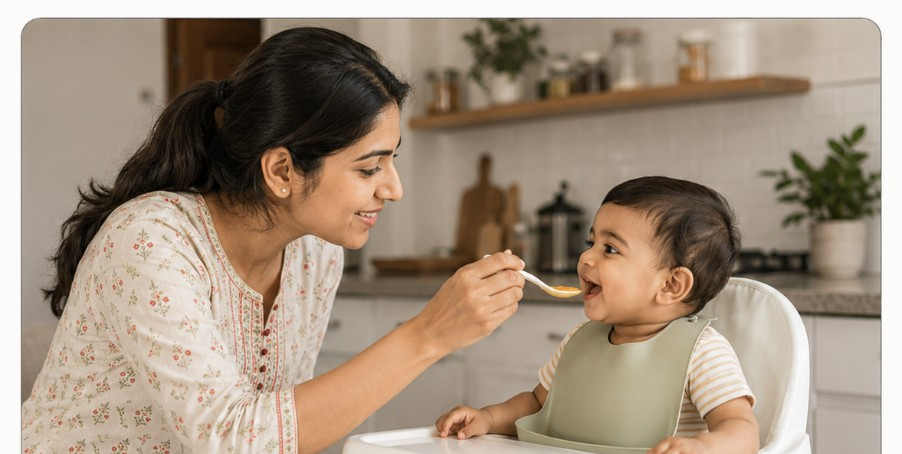
Many babies at this stage are offered a widening range of family foods alongside breast milk or infant formula, but appetite and routines vary a lot.
- Soft finger foods your baby can self-feed
- Iron-rich foods (dal, egg, well-cooked meat or fish, ragi)
- Cup practice with water at meals
- Responsive feeding — let appetite lead the amount
- Continue breast milk or infant formula
- No honey before 12 months; cow's milk not as the main drink before 12 months
- Limit high-salt and high-sugar foods
Feeding safety
- Sit your baby upright for every meal
- Supervise every meal — never leave a baby alone with food
- Avoid whole nuts and hard, round foods; cut foods into safe shapes
- Learn the difference between gagging (normal, noisy) and choking (silent)
Sleep
Common sleep pattern
Many babies around this age take two naps with a longer night sleep, though disruptions are common.
Why sleep may change
- Practising new skills like standing
- Separation anxiety
- Teething
- Nap transitions
What may help
- A predictable bedtime routine
- A calm, low-key response to night waking
- A consistent sleep environment
- Lowering the cot mattress once your baby pulls to stand
Safe sleep reminder
- Place your baby on their back to begin sleep
- Use a firm, flat sleep surface
- Keep pillows, bumpers, toys and loose bedding out of the cot
Play and activities
Peekaboo
Supports: Object permanence
Hide a toy under a cloth and reveal it.
Safety: Keep it gentle.
Container play
Supports: Pincer grasp
Drop blocks into a box and tip out.
Safety: No small parts.
Cruise set-up
Supports: Standing practice
Offer sturdy, stable furniture to hold.
Safety: Anchor furniture; clear corners.
Copy games
Supports: Imitation
Wave and clap and pause.
Safety: Floor level.
Babyproof before the next step
Mobility safety matters a lot at this stage. A quick sweep now keeps new skills safe.
- Anchor furniture and secure heavy screens
- Gate the top and bottom of stairs
- Cover electrical outlets and move cords out of reach
- Lock cupboards with medicines or chemicals
- Remove small choking hazards; pad sharp corners
- Check window and balcony safety
Growth
Growth is a pattern, not a weekly target.
What matters most
- Weight, length and head circumference tracked over time
- Whether your baby keeps following their own growth pattern
- Feeding, energy and overall wellbeing
- Any sudden change in the growth curve
Percentiles are read alongside the overall pattern — not used to diagnose on their own.
Vaccinations to check
There is no universal vaccine assigned solely to Week 32. What is due depends on several things, so check your baby's record rather than assuming a schedule.
What is due depends on:
- Previous doses already given
- The Universal Immunization Programme (UIP) schedule
- The Indian Academy of Pediatrics (IAP) schedule
- Your state programme
- Your paediatrician's guidance
- Any catch-up requirements
If you are signed in with a baby profile, your next recorded vaccine appears on your dashboard. Always confirm timing with your paediatrician.
When to contact a doctor
Seek urgent medical care
- Breathing difficulty or blue lips/face
- A seizure or loss of consciousness
- Baby is very difficult to wake or unusually floppy
- A serious fall or head injury
- Signs of severe dehydration
- Persistent vomiting with a worsening condition
Discuss promptly with your paediatrician
- Not bearing weight through the legs
- No gestures such as pointing or waving
- No babbling
- Does not respond to their name
- Feeding or swallowing concerns
- Loss of a previously acquired skill
Loss of a previously acquired skill should be discussed promptly.
ParentVibes offers general information, not medical advice or diagnosis. If you are worried, contact your doctor.
What comes next
Coming next: Week 33
In the coming week you may notice more of the patterns below as your baby grows — every baby at their own pace.
You may notice
- Cruising sideways along furniture
- Pointing to ask or show
- Standing with support for longer
One safety reminder
Anchor furniture and secure heavy screens
One play idea
Hide a toy under a cloth and reveal it.
Free personalised timeline
Get guidance matched to your baby's exact age
Add your baby's date of birth to see personalised weekly milestones, growth guidance and vaccination reminders.
Free to use • Your information stays private
Helpful for this stage
Frequently asked questions
Why does my baby cry when I leave the room?
Separation anxiety is a normal, healthy sign of attachment. Short, calm goodbyes and games like peekaboo help; it eases over the coming months.
When do babies pull to stand?
Pulling to stand often appears around 8–10 months. Lower the cot mattress and keep the cot clear as your baby practises.
What finger foods are safe now?
Soft foods cut to reduce choking risk — soft vegetable sticks, banana pieces, well-cooked dal. Avoid whole nuts and hard round foods, and always supervise.
Can my baby drink water from a cup?
Offering water in a soft-spouted or open cup at meals is a reasonable step, with supervision and plenty of mess expected. Milk still provides most fluids.
What should I discuss with my paediatrician?
Raise anything that worries you, and mention if your baby isn't bearing weight on the legs, uses no gestures, isn't babbling, or has lost a skill. Seek urgent care for breathing difficulty, a serious fall or severe dehydration.
When is the next vaccination?
Vaccination timing depends on your baby's record and the schedule your paediatrician follows. Check the immunisation card and confirm the next date with your clinic.
Sources & references
Formal milestone and safety guidance comes from the organisations below. Week-level framing is ParentVibes's editorial interpretation — none of these organisations publishes a specific “week 32” standard.
Learn the Signs. Act Early. — milestone checklists
Supports: Month-based milestone framework (not week-by-week)
Visit source →Improving early childhood development
Supports: Early childhood development guidance
Visit source →A parent's guide to safe sleep (HealthyChildren.org)
Supports: Safe sleep recommendations
Visit source →Baby — feeding, sleep and development
Supports: Feeding, sleep and baby-care guidance
Visit source →Indian Academy of Pediatrics — immunisation
Supports: Indian immunisation guidance
Visit source →Medically reviewed by Dr. Megha, MD, DNB (Paediatrics) · Last reviewed July 26, 2026
Reviewed for developmental, feeding, sleep and general-health accuracy. General information only — not a substitute for advice from your own paediatrician.
Read our editorial policy and medical disclaimer.